
THE CONTEXT
Access to electricity is a human right
Just to give you a background While many advocate for app development to enhance user experience, this approach may not be the most effective solution for off-grid customers. Access to electricity is a human right, yet over 600 million people in Sub-Saharan Africa lack clean, safe, and affordable energy. Many families must rely on dangerous, dirty energy sources like kerosene or unreliable products without after-sales care.
This is where Engie Energy Access steps in. We provide clean energy solutions to off-grid customers, offering a wide range of solar systems. Through MySol, we offer Africa's most comprehensive selection of PAYGo solar home systems. Our certified and quality-assured kits, proven in the field since 2011, cover home and business needs from 10W to 200W. With over 90,000+ customers across Nigeria, we're making a significant impact.

But having solar technology isn't enough if customers can't activate it. When families pay for electricity but have to wait hours on hold to confirm their payment, the technology fails its purpose. This was the problem I was hired to solve.
THE PROBLEM
The symptom was obvious. The root cause wasn't.
When I joined as CX & QA Manager Lead, the headline metric was alarming: 50% call answer rate. Half of all customers calling for support couldn't get through.
The immediate assumption was: "We need more agents." But I suspected something deeper. Why were so many customers calling in the first place?
Before adding headcount or changing processes, I needed to understand what customers were actually experiencing — and why our current system was failing them.
THE STAKES
⚡
Customers who paid for electricity sat in darkness, waiting hours on hold to manually confirm their payment had gone through before their meter would activate.
📉
In PAYG solar, a missed first payment is the strongest predictor of churn. When customers can't reach support during that critical onboarding period, they abandon the service entirely.
💰
Every churned customer meant hardware recovery from remote communities — expensive, logistically complex, and terrible for our mission of providing reliable energy access.
🌍
This wasn't just bad CX. It was a barrier to human dignity. Families who finally had access to clean energy couldn't use it because of a broken process.
THE RESEARCH
What I did to understand the problem
📞
Call Analysis
Analyzed 1,000+ call recordings across multiple weeks to identify patterns, categorize call reasons, and measure resolution quality
🗣️
Agent Interviews
Shadowed 25+ CSMs to understand their daily frustrations, workflow bottlenecks, and why they couldn't answer more calls
📊
Volume Mapping
Mapped call volume against payment due dates, onboarding timelines, and agent schedules to identify systemic mismatches
WHAT THE DATA REVEALED
70%
Payment confirmation calls were the dominant call driver. Customers had to manually call the call center after every payment to confirm it had gone through before their electricity would activate. This wasn't user behavior — it was a broken system design. Every payment generated a preventable call.
3x spike
In PAYG solar, a missed first payment is the strongest predictor of churn. When customers can't reach support during that critical onboarding period, they abandon the service entirely.
Zero friction
Every churned customer meant hardware recovery from remote communities — expensive, logistically complex, and terrible for our mission of providing reliable energy access.
English only
All onboarding communications were in English — in a multilingual market. Non-English-speaking customers didn't understand the PAYG payment model after sign-up, leading to confusion, missed payments, and early churn.
JOURNEY MAPPING
Where the experience was breaking down
I mapped the full customer lifecycle to pinpoint exactly where friction occurred. The journey revealed that the problem wasn't during the call — it was that customers had to call at all.
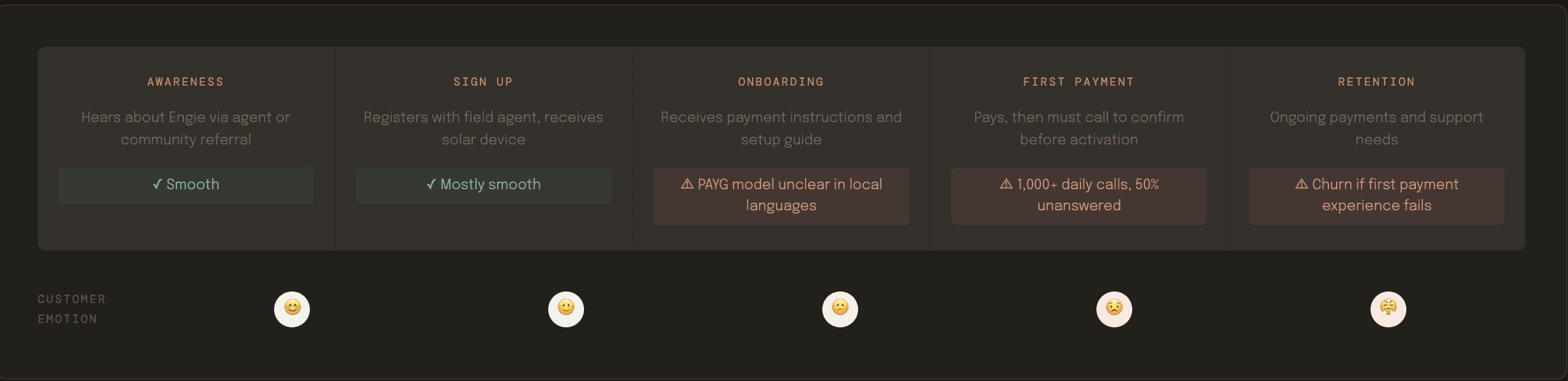
The insight: The broken experience wasn't about agent training or capacity — it was about a payment system that required manual human intervention for every single transaction. We'd designed a process that couldn't scale.
THE SOLUTION
Fixing the system, not just the symptoms
Instead of hiring more agents to handle more calls, I redesigned the experience to eliminate the need for most calls entirely. The solution had two core interventions:
01
Virtual Account Numbers
I worked with the payments team to implement unique virtual account numbers for each customer. When a customer paid, the payment automatically reflected on their meter — no call needed, no manual confirmation, instant activation.
02
Multilingual Communication System
Recognizing Nigeria's linguistic diversity, I led the implementation of local dialect support across all customer touchpoints — SMS payment reminders, IVR menu options, and onboarding materials in customers' preferred languages.
But systems change requires operational redesign too. I couldn't just fix the payment flow and walk away — I needed to build the infrastructure that would sustain these improvements.
IMPLEMENTATION
How I redesigned the operations
01
Payment System Redesign
Collaborated with engineering and finance to implement virtual account number infrastructure. Tested with pilot cohort, refined edge cases, then rolled out to 90,000+ customers.
02
Multilingual Content Design
Redesigned onboarding SMS and IVR scripts in local dialects. Simplified language, added payment reminders timed to each customer's due date, tested comprehension with native speakers.
03
QA Framework Design
Built a quality scoring rubric from scratch — defining standards for tone, resolution, accuracy, empathy. Designed it to generate coaching insights, not just performance scores.
04
Demand-Led Staffing
Used call volume data to identify predictable peak periods. Redesigned shift structures to align agent availability with actual customer demand patterns.
05
Coaching System
Introduced weekly coaching sessions tied to individual QA scores — turning performance data into development conversations, not just team metrics reviews.
06
Journey Optimization
Mapped the full customer lifecycle, identifying friction points beyond the payment flow. Redesigned onboarding touchpoints for clarity and reduced drop-off.
OUTCOMES
What the redesign delivered
Beyond the metrics: Every percentage point increase meant hundreds of families with reliable access to clean energy. The instant activation system meant children could study at night, small businesses could operate after dark, and communities gained dignity through reliable electricity access.
REFLECTION
What I learned
What this taught me
Operations problems are almost always design problems. The 50% answer rate looked like a staffing issue. It was actually a payment system design failure that was generating thousands of preventable calls. Hiring more agents would have been expensive and wouldn't have fixed anything.
Agent Interviews
I focused on prevention, not management. Most CX teams would have optimized the call handling process. I eliminated the need for most calls entirely. The virtual account number system didn't make calls faster — it made them unnecessary.
I'd start with Voice of Customer research earlier.
I built the QA system from call data alone. Direct customer interviews in month one would have surfaced the language barrier problem much faster than pattern analysis did.